Wednesday

Splice (2010)

★ ☆ ☆ ☆


**Spoiler Alert**


Ordinarily, I do my best to avoid spoilers. However, I think it would be a disservice in this case. Simply put, Splice is the most disgusting movie I have ever seen. It is the only movie that has ever made me feel physically ill. Inter-species sex? Really? I can't imagine why anyone would want to see that. I guess it wouldn't be so bad if there were redeeming qualities in the movie. There weren't. Sadly, the critics loved it. It was widely considered an intelligent exploration of the moral dimension of genetic engineering, and a parable for the difficulties of parenting. What rubbish. It had all the moral complexity that you would expect from a dinner table political discussion.

Splice is about a genetic experiment, which leads to the creation of a human/animal hybrid. The experiment began as an attempt to create a new medicinal compound, quickly spun out of control. In short, it is a diatribe against genetic engineering. While I'm sympathetic to this position, I was disapointed by the simplistic approach director Vincenzo Natali took to the issue. He aimed for a purely visceral reaction, which is exactly what he got. However, I'm not sure it actually caused anyone to think any deeper about the issue.

For a movie that has been praised for it's treatment of complex moral issues, the dialogue was surprisingly amateurish. The rushed conversations were filled with talking points, and flippant reversals. It felt like a made for tv movie, with slightly better special effects. While Adrian Brody wasn't terrible, Sarah Polley put in a performance unworthy of a b-movie. Instead of the suspense that it aimed to create, the film elicited little more than unintentional giggles, and a good deal of disgust from the audience. Guillermo del Toro should be embarrassed to have lent his name to such an amateurish production.

It seems that the entire purpose of Splice was to 'push the envelope.' Given that critics seem to mistake edginess for thoughtfulness, this was probably a good marketing ploy. Ironically, I wouldn't be surprised if this tactic was self defeating. After all, this project received $2.5 million from TeleFilm Canada, a Canadian Government funded cultural agency. Given the number of people who left the theatre in disgust, I wouldn't be surprised if there were calls to review Canadian film subsidies. Though I'm against most forms of censorship, it's hard to blame people for not wanting to fund films that they find incredibly offensive. If there is a market for inter-species sex scenes, film companies should be able to raise the money themselves. Somehow, I doubt that this market exists.

Tuesday

Robin Hood (2010)

★ 1/2


If someone had told me last year that the two most disappointing movies of 2010 would be Tim Burton/Johnny Depp, and Ridley Scott/Russell Crowe collaborations, I might not have believed them. Sadly, this is how it turned out. Robin Hood was muddled, boring, and historically revisionist. I'm a huge fan of the surge of reinventions that have been turned out in the last few years, but Robin Hood crossed a line. It is fine to make up historical events, but it's another thing to re-write one of the most important events in human history. Worst still, unlike Gladiator, the historical fabrications actually detracted from the legend. This is Ridley Scott's fourth botched history lesson. He should stick to fiction.

Even if we ignore the numerous offenses against history, there is not much of interest in Robin Hood. It strayed too far from the original legend. The central point of the Robin Hood legend--reclaiming tax dollars from the rapacious Sheriff of Notingham--was hardly even an afterthought. The plot was too ambitious. Fabricating a connection between Robin Hood and the Magna Carta neither made the plot more interesting, nor did it make it more politically relevant. In fact, it undermined what ought to have been an extremely timely political message. Several commentator argued that Ridley Scott turned Robin Hood into an icon of the Tea Party. That is exactly the opposite of what he did. Rather, he took a tax crusader, and turned him into an crusader for representative government. The two are by no means incommensurate, but they are different issues altogether.


Perhaps the most dissatisfying part of the film is that it simultaneously attempted to de-mythologize Robin Hood, while leaving in several mythological aspects. The most notable of which would be the legend surrounding his lineage. The number of coincidences involved in this subplot could be forgiven in mythology, but not in a gritty realistic reinvention (which is what Scott presumably was trying to create.) This is especially true, given that the entire subplot was invented to make Scott's Quixotic point.

Aesthetically, the movie turned out about average. There was an early siege scene that was done quite well, though there were a fair share of scenes that were poorly done. Most notably, there were several musical scenes, most of which seemed like irritating fillers. There were also several scenes with extremely choppy cinematography that was hardly worthy of a made for TV movie. There wasn't really anything wrong with the acting. It was an average role for Russell Crowe--in other words, the role was better than average. Cate Blanchette was about as depressing as Scott intended her to be, so mission accomplished for her.

If you're just looking for an action flick where plenty of heads role, you may enjoy this. Otherwise, save your money. It was 140 minutes of my life I wish I had back. You can blame screenwriter Brian Helgeland if you like, but Ridley Scott set the creative direction. Besides, who in their right mind would hire the screenwriter who wrote The Postman?

Sunday

Iron Man 2

★ ★ ★ ☆


I have to say right off the bat that I was not a big fan of the original Iron Man. It was similar to Christopher Nolan's Batman series, but lacked the depth. It was a beta version, at best. To my great surprise (and contrary to the critics), Iron Man 2 surpassed the original in every way imaginable. Not only was it more fun than the original, it was actually quite thought provoking. Though it doesn't delve into the deep philosophical territory of The Dark Knight, it deals with many of the same themes in a more accessible manner. I now see the Iron Man series as a complement to Nolan's Batman series, rather than an inferior competitor.


While the critics were generally positive towards Iron Man 2, they failed to acknowledge it as anything more than an adequate sequel. The sequel was more entertaining, and more insightful. The first installment dealt with the themes of vigilantism, and technological change, but not in a way that was particularly interesting. The second installment builds on both of these themes. While the first movie created the impression that Iron Man could keep the world secure, the second demonstrated the instability of this situation. The problem is that the world isn't static. Not only is Iron Man's technological supremacy fleeting, but he will not be around forever. The great strength of Iron Man 2 is that it is more than just a superhero movie: it is a statement about international relations, and security in general. What we witness is not merely a battle between good and evil, but a genuine arms race.


When critics chided the plot for being "clunky," or "confused," they failed to appreciate this central point: real life is messier than Hollywood fairy tales. The introduction of multiple new characters--many of ambiguous significance--accentuated this point. There is a great deal of uncertainty right up until the end. Who are the real players? Is Iron Man the earth's savior, or is he merely a puppet of SHIELD? And what about Vanko? Is he the most significant villain, or is was he merely the first to put a dent in Iron Man? This made the movie interesting, not muddled.


The critics were right about a couple of things. First, there was no major climactic battle scene. I agree that this was the case, but it is partly related to my previous point. It's hard to have a climactic scene when you don't even really know who the players are. The second thing they pointed out was that the sequel had a much more light hearted tone. Most of them were happy with this. Frankly, so was I. The series was never meant to have the same gravitas as the Batman series, and trying to create that tone would likely have backfired (as it usually does with comic book movies). Injecting some humour into the movie was the right way to go. This suited Robert Downey Junior just fine. I don't personally know RDJ, but Tony Stark was an uncanny portrayal of RDJ's public persona. He not only fit the role, but he genuinely seemed to enjoy himself. While this role didn't approach his masterful portrayal of Sherlock Holmes, it was definitely another home run for RDJ.


Aside from Downey, there were plenty of great casting decisions. Sam Rockwell played a great counterpart to RDJ. While his character evolved dramatically, it never felt contrived. He seemed to grow right into the role. Mickey Rourke was predictably solid, and Samuel Jackson was well cast. My only casting complaint is Scarlett Johansson. I've never found her to be particularly talented, so I assume that she gets her parts based on her appearance. Frankly, there are much more talented actresses who happen to be more attractive. It's no coincidence that the worst scene in the movie was the one where she played the largest role.

Jon Favreau deserves some serious credit. He has created a comic book movie that is both fun, and though provoking. This is a rare, if not unique achievement. He may not be Christopher Nolan, but he sure knows how to entertain an audience.

Tuesday

A Prophet (2009)

★ ★ ★ ☆


I suppose the fact that I refrained from giving A Prophet four stars could be construed as fairly harsh criticism. I assure you that I'm not going to go all Armand White, though I did enjoy his overstated review. A Prophet was a very enjoyable film, laced with several riveting scenes. The first murder scene (yes, there's a murder in a movie about prison violence) is among the most intense scenes you'll see anywhere. The themes of Arabs in French culture, and the prison as a farm team for criminal organizations were handled particularly well. Good as it was, it was far from perfect.

From a technical standpoint, A Prophet was pretty solid. The acting was great all around; the cinematography was exceptional. Malik (Tahar Ratim) maintained a prophetic demeanor (as it were), even in the most chaotic scenes. Director Jacques Audiard was able to create (what I assume to be) a more authentic incarceration experience than most viewers have ever experience. He managed to capture the claustrophobia, the degradation, and the sheer terror of
life in a maximum security prison.

My problems were twofold. First, I couldn't stand the ending. When contrasted with it's closest cousin, The Godfather, it's ending comes up short. To avoid spoilers, I will refrain from further comment on this point. Second, the prophetic elements muddled the point of the film. There were the subtle allusions to Muhammad, such as the 40 days in solitary, which added greatly to the film, and then the supernatural elements, like his prophetic dreams. The supernatural elements were problematic, from a normative perspective.


Essentially, A Prophet can be interpreted as an allegory for the rebellion against colonialism. After all, it is about an immigrant prisoner, who can neither read, nor write the language of overseers. He is taken on as a servant by the Sicilian prisoners, who treat him like a dog. The combination of the anti-colonial theme, and the quasi-religious elements bothered me. If religious assumptions are going to be incorporated into a film, it should be done without losing site of the moral implications. If Malik is actually a prophet, then what do his brutal actions tell us about his faith? Are drug lords the new shepherds? Either Audiard is implying that there is a God, who is quite evil, or is being inconsistent. I assume the latter is the case.

In an interview, Audiard stated that "The character of the Prophet heralds this new criminal prototype: he’s not a psychopath, he’s intelligent and almost angelic." This is what makes Malik fascinating. The religious allusions are great, but the outright supernatural elements bring up too many metaphysical questions that undermine the film. Though A Prophet is not perfect, it is a must see. Just don't let the hype create unrealistic expectations.

Sunday

Things We Lost In The Fire (2007)

★ ★ ★ 1/2


Some actors are typecast early in their careers. They are doomed to play the same role over and over, with decreasing success. Benicio Del Toro is one of the rare exceptions to this rule. Most of Del Toro's major roles have dealt with drugs, and addiction. Even his most recent role, The Wolfman dealt with the subject of addiction obliquely. Yet somehow, Del Toro seems to add an additional layer of complexity to his oeuvre with each role. In Fear and Loathing, he played a comedic, yet frightfully erratic junkie. In Sin City, he played a merciless, abusive drunk. His character in Things We Lost In The Fire provides a stark contrast.

Things We Lost In The Fire is a story about the fallout of a homicide. Audrey (Halle Berry), plays a widow, left with a young family, and the grief of her husband's recent death. Jerry (Del Toro), her husband's best friend, is a drug addict who is shaken by the death of his only friend. Jerry has avoided Audrey for years, since she disapproved of her husband's relationship with a heroin addict. Were it not for her husband's demise, she may not have ever seen him again. He likely would have died in an alley somewhere. This is how she felt it ought to have been.


This was arguably Del Toro's best role to date. Jerry seems to represent a best case drug rehab scenario, though we're always aware of his vulnerability. He is eerily detached, especially when listening to music or having a cigarette. He seems to immerse himself in these activities the way that only a recovering addict could. Halle Berry was no slouch either. There is a fine line between depressed and mopey. She deserves major credit for straddling that line. It's rare to see two actors so excel in such difficult roles simultaneously. There was a kind of synergy that is quite rare.

Though the acting made the movie, Susanne Bier's gritty directorial style certainly complemented the leading roles. Shifty camcorder shots helped accentuate the sense of disarray. This disarray would momentarily stop every time the camera peered into Halle Berry's eyes, or paused on Del Toro's face. It's as though Bier was trying to plunge the audience into the depth of their souls. From this close, we could just see that tiny glimmer of hope left for them. This is one of the most mature, and ultimately hopeful cinematic treatments of grief, and addiction. A wonderful English language debut for Susanne Bier.

Saturday

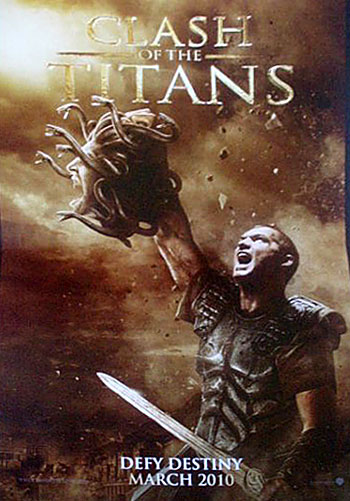
Clash Of The Titans (2010)

★ ★ ☆ ☆


Generally my expectations for action movies are quite low. Things blow up, the bad guys die, and we all live happily ever after. My expectations were a bit different for Clash of the Titans. Given how heavily it relies upon supernatural phenomena, I assumed that it was either going to be really good, or really bad. As a movie about a war between mortals and deities, there are obvious logical problems that can hinder the film. Given the fuzzy metaphysical assumptions that are adopted, any sort of realism is nearly impossible to achieve. The only potential saving grace would be if that very metaphysical scheme made an interesting philosophical point. From the outset, it seemed likely that it would be a train wreck.

Admittedly, I was wrong: Clash of the Titans was neither good, nor bad. It did a reasonable job of reigning in the excesses of supernatural movies, though didn't achieve the philosophical importance of a film like 300. Sam Worthington, Liam Neeson, and Ralph Fiennes all put in respectable performances. Louis Leterrier deserves credit for taking a difficult screenplay, and making it watchable. While the screenwriters didn't entirely drop the ball, they wrote in their fair share of cliches and fell into some of the expected traps of supernatural films. I was satisfied, though after having walked out of Alice in Wonderland, I'd have been happy with just about anything.

Alice In Wonderland (2010)

★ ☆ ☆ ☆


There isn't much to say about Tim Burton's Alice. It was the first movie that I actually walked out of and got a refund. The CGI was creepy, and the subtexts were extremely lewd for a kids movie. I don't think Burton really knew who his audience was. It isn't really appropriate for children, yet is completely uninteresting for adults. As a big fan of Tim Burton, and an even bigger fan of Johnny Depp, I was extremely disappointed (though I couldn't sit through enough of it to actually see Johnny). I'm at a loss for words.